

Therapists you may want to meet
You can name a therapist in your request or ask intake to help you choose. These profiles describe experience, not current openings. Intake confirms fit, age range, scheduling and access to a particular treatment.

Alison Tripptree
Clinical PsychologistWorks with sexual orientation and gender identity exploration, relationship concerns and trauma. Her biography describes writing letters in support of gender-affirming surgery.

Blake Macko
LSWWorks with LGBTQIA+ people navigating identity, trauma, anxiety and relationship concerns, with experience in university counseling and community care.
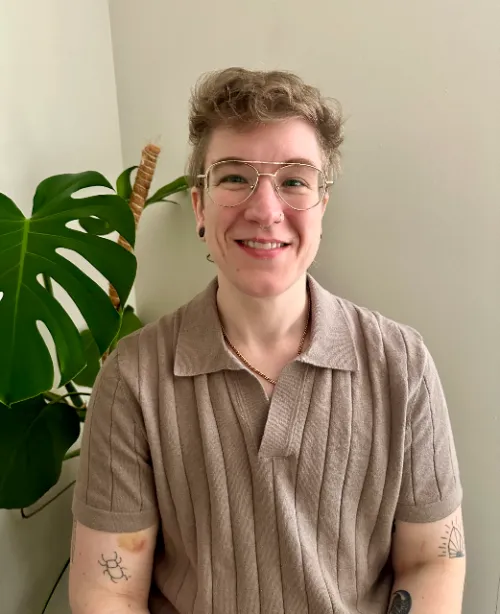
Ellis Matthews
LPCWorks with people ages 14 and older, including LGBTQIA+ clients, with a focus on developmental and relationship trauma and an anti-oppressive approach.
What affirming care means here

Your sexual orientation or gender identity is not a problem for therapy to correct. Affirming care respects your identity, recognizes the effects of stigma and makes room for your strengths, relationships and sources of joy.
Your therapist should take responsibility for learning about LGBTQIA+ experiences while listening to what is particular to you. You can ask about relevant experience, say when something is misunderstood and discuss what you need from the relationship.
If you are exploring, there is no required label or outcome. If you know who you are and want help with anxiety, grief, work or something else, identity does not have to be the focus.
Sources: APA: Practice with sexual minority people · APA: Transgender and gender-diverse care resources
Stress, support and belonging

Discrimination, rejection and having to judge whether it is safe to be open can add to everyday stress. Ilan Meyer’s minority stress model describes these social pressures, including anticipated rejection, concealment and internalized stigma. They may help explain part of a person’s experience; they do not explain every difficulty or define an LGBTQIA+ life.
Source: Meyer (2003): Minority stress
In its 2024 online survey of LGBTQ+ people ages 13 to 24 in the United States, The Trevor Project found an association between accepting communities and fewer reported suicide attempts. This was an observational survey, not a trial showing that one form of therapy caused the difference. It highlights the importance of support alongside the barriers young people can face.
Source: The Trevor Project: 2024 US survey
We can talk about safety, relationships, community and the parts of your life that feel sustaining, as well as pain or exclusion. Your identity is not a diagnosis, and population statistics are not a prediction about you.
What you can bring to therapy

Coming out and identity exploration
Coming out can involve separate decisions with friends, family, at work or in health care. You decide whether, when and with whom to share. Your safety, privacy and relationships matter; there is no requirement to come out in order to do useful work in therapy.
You may be questioning for the first time, revisiting an earlier understanding or coming out later in life while considering a marriage or family relationships. We can explore uncertainty, losses and possibilities without pushing toward a label.
Transgender, nonbinary and gender-questioning support
We welcome transgender, nonbinary, genderqueer, gender-fluid and gender-questioning people. You may want to explore names, pronouns, presentation, relationships or decisions about social or medical transition. Some people want medical care; some do not.
Therapy can make room for joy, uncertainty, grief or relief, including feelings that change over time. Support with exploration is different from an assessment requested for particular medical care. We can discuss what you are seeking and whether the clinician’s experience fits.
Sources: APA: Transgender and gender-diverse care resources · WPATH Standards of Care, version8
Gender-affirming care letters
Some clinicians here provide gender-affirming care letters; Alison Tripptree’s biography describes experience writing letters supporting surgery. If you need documentation for surgery or hormone care, ask intake about the service, the appropriate clinician and the assessment involved.
Requirements depend on the requested care, the receiving provider and sometimes the insurer. WPATH’s Standards of Care are clinical guidance, not a guarantee that every service needs a letter or that any therapist can write one. Existing clients can discuss the request with their therapist; new clients can ask intake about the process, timing and fee before scheduling.
Source: WPATH Standards of Care, version8
Internalized stigma and shame
Messages about sexuality and gender can affect how you see yourself, even after you reject them intellectually. You might notice self-criticism, fear of being judged or difficulty feeling comfortable in relationships or community spaces.
Those experiences can have several influences. We can explore whether stigma is part of your experience and work toward choices that reflect your own values, without assuming a particular history or cause from your identity.
Source: Meyer (2003): Minority stress
Relationships and couples therapy
You can ask about work with same-sex partners, mixed-orientation relationships, polyamorous or consensually non-monogamous relationships, and partners navigating a gender transition. Intake can help identify a clinician whose relationship-work experience fits your needs.
Communication, intimacy, agreements and conflict may be part of the work. Different levels of outness, family responses or discrimination may also affect a relationship. The relationship structure itself is not a diagnosis. Ask about couples fees and coverage separately from individual therapy.
Source: APA: Practice with sexual minority people
Family of origin and chosen family
Rejection or pressure from family can be painful. You may want to discuss boundaries, contact, grief about the relationship or ways to seek support. Research has linked family rejection with poorer mental-health outcomes in studied groups; it does not determine an individual’s future.
Friends, partners, mentors and community members may be part of your chosen family. Those relationships can offer belonging and also have their own conflicts, losses and changes. We can make room for both.
Source: Ryan et al. (2009): Family rejection and health
Grief and loss
A partner described as a friend at a funeral, relationships that changed after coming out, years spent hiding or community members lost to violence, AIDS or suicide may carry grief. You may also have losses unrelated to identity. What the relationship or experience meant to you matters.
Intersecting identities and experiences
Race, culture, disability, faith, immigration experiences and finances may shape what feels possible and where you feel understood. For some people, racism in queer spaces or homophobia or transphobia elsewhere can complicate belonging. We will ask what is relevant for you rather than assume.
You may want to keep a connection with faith, change that relationship or process harm within a religious community. Therapy should leave room for your choices and for parts of your life that do not fit a simple story.
Source: APA: Practice with sexual minority people
Philadelphia community connections
Our office is in Old City. Philadelphia’s LGBTQIA+ communities include the Gayborhood and many other neighborhoods, organizations and networks. In 2017, the city’s More Color, More Pride campaign introduced black and brown stripes to recognize LGBTQ people of color.
Source: City of Philadelphia: More Color, More Pride
Mazzoni Center and William Way LGBT Community Center are independent local resources. Their websites provide current services, programs and visiting information. Mazzoni announced in 2025 that the Philadelphia Trans Wellness Conference would shift to year-round programming as the Charlene Arcila Trans Wellness Collective. Check their websites for the latest program and visiting details.
Sources: Mazzoni Center: Trans Wellness programming update · William Way LGBT Community Center
Mazzoni Center William Way LGBT Community Center
What to expect in therapy
The first session is a chance to talk about what is happening, what you want help with and whether the therapist feels like a useful fit. You can ask questions, decide what to share and say when an interpretation or approach does not fit your experience.
Sessions are 53 minutes and usually weekly. You and your therapist can discuss the frequency and length of care, your goals and how the work is going. If you feel worse, stuck or concerned about the work, bring that into the conversation so the plan can be reviewed.
Appointments in Old City and by video
Our office is at 123 Chestnut Street, Suite 304, in Old City, Philadelphia. Visits are by appointment.
Video appointments depend on where you are located during the session and on the clinician's authorization to practice there. Ask intake about Pennsylvania or New Jersey options.
Plan your office visit About telehealth
Getting started
- Tell us what you are looking for. Our adaptive form asks about your concerns, schedule, in-person or video preference, and insurance or self-pay plans.
- Talk through a therapist match. Our intake team reviews your request and follows up about fit, scheduling and payment. You can name a therapist you are interested in or ask us to help you choose.
- Arrange your first appointment. Once a suitable match and appointment time are confirmed, you will receive the information you need to begin.
We aim to reply within 1 to 2 business days. A reply is the start of the conversation; the timing of a match and appointment depends on fit and current availability.
How getting started works Plan your office visit
Costs and insurance for LGBTQIA+ affirming therapy
Individual-therapy fees generally range from $130 to $200 per session. Confirm your appointment fee with intake. With insurance, your cost depends on the specific plan, clinician, service and any deductible, copay or coinsurance.
Turning Leaf works with select Aetna, Blue Cross Blue Shield, UnitedHealthcare and Optum plans. The Blue Cross plans listed on our site include Highmark, Capital, Anthem, Anthem New York (formerly Empire), FEP and Horizon NJ. A carrier name alone does not confirm that an appointment is covered. Intake can help check your expected benefits and costs.
Coverage depends on your plan’s requirements, including medical necessity. Seeking support for a life experience or identity question does not by itself establish an insurance-covered diagnosis or guarantee coverage. You can ask intake to help check benefits and discuss self-pay options before scheduling.
Independence Blue Cross, including Keystone Health Plan East, and Cigna are out of network. If your commercial plan has out-of-network benefits, we can provide a superbill on request. Ask your insurer about reimbursement rules and your share of the cost. Pennsylvania VCAP is a separate victim-compensation program; ask intake about using approved assistance for therapy.
We are not accepting new clients enrolled in Medicare or Medicaid, including Medicare Advantage, Pennsylvania Medical Assistance and NJ FamilyCare, even if they wish to pay privately. Please ask your plan for participating therapists. Existing clients whose coverage changes should contact their therapist and intake team.
Plans and coverage details Rates and payment options Pennsylvania VCAP Medicare and Medicaid policy
Frequently Asked Questions
What is LGBTQIA+ affirming therapy?
It is care that respects LGBTQIA+ identities and relationships, recognizes the possible effects of stigma and follows your priorities. You can explore identity or work on another concern. Your therapist should listen, ask rather than assume and respond when you say something does not fit.
Sources: APA: Practice with sexual minority people · APA: Transgender and gender-diverse care resources
What is the difference between LGBTQ-friendly and LGBTQ-affirming?
Friendly can describe an attitude; affirming care involves how a clinician actually works. Ask about relevant experience, training, respectful language and how identity and social context are considered. A website label alone does not establish competence.
Do I need to be out to start therapy?
No. You can begin while questioning, while keeping your identity private or after being out for years. We can discuss what you want from therapy without requiring disclosure outside it. Ask your therapist to explain privacy and its limits, especially if you are a teen or use someone else’s insurance.
Can a straight or cisgender therapist be LGBTQIA+ affirming?
Yes. Relevant knowledge, experience, respectful practice and the relationship you build all matter. A shared identity may be important to you, but it does not automatically establish a good match. You can tell intake about your preferences; matching depends on fit and current availability.
Do you provide gender-affirming care letters?
Some clinicians do. Ask intake or your existing therapist about the care you are seeking, the receiving provider’s requirements and whether an appropriate clinician can provide an assessment and documentation. Letters are not automatic, and the process, timing and fee should be discussed before scheduling.
Do you offer couples therapy for LGBTQIA+ relationships?
You can ask about a clinician who works with your relationship concerns and structure, including same-sex, mixed-orientation, polyamorous or consensually non-monogamous partnerships, or a partner’s gender transition. Intake can explain fit, couples fees and coverage before scheduling.
Does insurance cover LGBTQIA+ affirming therapy?
Coverage depends on the specific plan, clinician, service and medical-necessity requirements; identity itself is not a diagnosis. We work with select commercial plans. Independence Blue Cross and Cigna are out of network. We are not accepting new clients enrolled in Medicare or Medicaid, even if they wish to pay privately. Existing clients whose coverage changes should contact their therapist and intake team. Ask intake about expected benefits, costs and payment options.
What issues can I work on?
You can discuss anxiety, depression, relationships, coming out, gender, stigma, family rejection, grief, trauma or other concerns. Your identity may or may not be central. Intake can help you find out whether a clinician here offers the care you need.
How much does therapy cost?
Individual sessions generally cost $130 to $200 for self-pay, depending on the clinician. Insurance costs vary by plan and service. Ask about the specific fee for individual therapy, couples work or a requested assessment or letter; the individual-session range does not establish every service’s price.
How can I tell whether a therapist is a good affirming match?
Ask about experience with the concerns you want to address and how the clinician approaches identities or relationships like yours. Notice whether your language is respected, questions feel relevant and feedback is welcomed. You can discuss a mismatch or ask intake about another clinician; you do not have to decide from a label, pronoun listing or first impression alone.
How long does therapy take?
It depends on what brings you in and what you want from therapy. Some people come for a focused stretch around a specific concern, while others choose longer, open-ended work. If you feel worse, stuck or concerned about the work, bring that into the conversation so the plan can be reviewed. You and your therapist will revisit your goals over time.